The AWP Tribal Colleges & Universities Fellowship Program officially launched at the 2025 AWP Conference & Bookfair in Los Angeles, California, on March 26–29, 2025. AWP was honored to award fellowships to one faculty fellow and four student fellows from tribal colleges and universities across the country.
The #AWP25 cohort was led by the inaugural creative advisor, Jake Skeets, member of the Navajo Nation and author of Eyes Bottle Dark with a Mouthful of Flowers, winner of the National Poetry Series, American Book Award, Kate Tufts Discovery Award, and Whiting Award. As the program’s creative advisor, Skeets got to know the five fellows during a private discussion over lunch and later gave a public lecture (“Emergence & Becoming—Framing Native Poetics Beyond the ‘Renaissance’”) to conference attendees on Native storytelling traditions and the great expanse of its past, present, and future.
The faculty fellow served as a mentor to her student fellow mentees for the duration of the conference. During its inaugural run, it was clear that the enthusiasm for Indigenous American writers was present, as was the overwhelming support for the program itself. Such an experience was made possible through the wholehearted participation of the creative advisor and fellows. Below are personal reflections of all participants of the first year of the AWP TCU Fellowship Program.
—Autumn Hutson, Membership Services Coordinator
Jake Skeets
Creative Advisor
There’s something comforting when I’m in a Native space. Granted, all of the country is Native land, but it does not feel like it most of the time. As a Native writer, as a Diné writer, I’ve always sought out Native spaces whenever I’m away from home. As an undergrad, I chose to stay close to home. I began my teaching career at Diné College. I chose the University of Oklahoma because they were specifically looking for a Native writer and Oklahoma is home to several Native Nations. Now, as I grow older, I understand the deeper responsibility of creating Native spaces and offering room to those searching for community. AWP has been putting real effort into creating these spaces and I’m so honored they thought of me to help with the TCU Fellowship. I was able to sit down with the fellows and learn from them and with them. We were able to find community in the middle of a large city. It is a unique strength of Black, Indigenous, and migrant communities: the ability to conjure home in places that try to sever ties with history in pursuit of progress.
#AWP25 felt truly like a Native space and it makes sense because Los Angeles is a very Native space. When the government attempted to assimilate Native people, they offered one-way bus tickets to cities like San Francisco, Los Angeles, Denver, and Dallas. The instinct to find home regardless of surroundings is a very human instinct, one strengthened by time. Native people in the early days of Indian Relocation, as it’s been named, were resilient and able to conjure space by and for Native people.
In a similar way, Native writers have had to conjure these spaces in national literary organizations largely on their own. However, more and more institutions are beginning to support Native writers in shaping our communities and conversations in these broader literary spaces. At #AWP25, Native writers from across the country were able to come together and celebrate Native literature and its past, present, and future. From the Institute of American Indian Arts to NDN Girls Book Club and Indigenous Nations Poets, Native writers have been putting in real labor to create spaces by and for Native communities within these national platforms. The panels reflected a wide range of Indigenous-focused topics, and Native writers were included in conversations that felt urgent and necessary for today’s climate. Erasure and displacement are all too familiar for Native voices, so it makes sense to look to Native writers to help us survive crisis after crisis. Our stories echo with oppression’s memory, warning against the technologies of empire, but they also hold glimmers of the future and the language to describe it.
The highlight of my time at AWP was the TCU Fellowship Program Reception. It was great to be in the presence of so many great writers. Contained in one small room was decades of story, so many ancestries and lineages condensed into a single space, and I could feel the energy vibrating in the air. It was all the sun I needed, especially since the California sun was oddly absent that week. There’s a kind of magic that happens where story gathers and for me, Native spaces will always be that place.

Faculty Fellow
Shaina Nez
Diné College
Attending the AWP Conference in Los Angeles, California, as part of the TCU Fellowship was a full-circle moment.
On the first day of the conference, I had the pleasure of spending the morning with fellow TCU recipients, Chris and Shannel, while preparing to facilitate an AWP panel. The panel, “How to Teach Diné Literature,” featured Natanya Pulley, Tacey Atsitty, and me—Navajo authors and poets discussing approaches to teaching, challenges in the classroom, and ways to engage students in Diné literature. The audience was receptive to our experiences, and many came to visit our table before we wrapped up. I want to express axhé’héé’ to Esther Belin for inviting me to facilitate this event and for being there every step of the way.
That evening, we attended the AWP TCU Fellowship Program Reception and saw so many familiar faces—from IAIA’s MFA creative writing program to folks at Words of the People, Abalone Mountain Press, and Indigenous Nations Poets. A former student of mine, Jalen Smallcanyon from Diné College, showed up to support her peers who received the TCU Fellowship. It was incredible to witness how far the literary landscape has come, shaping their sense of literary citizenship in ways that honor kinship and responsibility. Seeing these young people embody and extend those values—often unknowingly—showed me how much potential the literary world has to evolve and create meaningful change, especially in spaces back home.
I want to give a special shout-out to the panelists of “Future Work / Beauty Work: A Reading Featuring New Diné Poets.” I sat in the back row, taking photos on my iPhone and sending them to the panelists so they could have them as memories and inspiration. Supporting the voices of Christopher Hoshnic, Cheyenne Williams, Jalen Smallcanyon, and Jalen Charley was necessary. I tapped into full-on “mom mode” and superfan energy—and I hope that in doing so, they’ll see me not just as a mentor, but as someone who stands with them in relationality.
I met Jalen Charley back in 2019 at the Emerging Diné Writers’ Institute. We were both fellows then, and seeing how our paths have grown since that time hit me right in the heart. The emotion stayed with me when I saw Jalen Smallcanyon again—a student I first met outside the NHC building next to the Warrior Café on Diné College’s main campus in Tsaile. I remember asking if she’d be interested in being part of a promotional video for the BFA creative writing program. From that moment, I saw her light. Her leadership, her advocacy—she’s a force. I always valued her ideas when I was a faculty member, and I did everything I could to show her what the literary landscape could be for Navajo women, especially through a justice and social inquiry lens.
And then, my Daii—Christopher. I truly believe that poetics from this side of Sweetwater are in good hands with his vision, leadership, and filmmaking talents. In the short time I’ve gotten to know Cheyenne, I’m already blown away by her editorial work with The Independent, the campus magazine at Fort Lewis College. Once upon a time, I was a reporter for that same magazine as an undergrad. Now, a decade later, there’s a Diné editor at the helm—and all I can say is: about damn time. Sending hugs your way, Cheyenne.
I can’t wait to see these four—Chris, Cheyenne, Jalen, and Jalen—signing their poetry collections in front of packed rooms. I know the challenges they’ve faced, the risks they’ve taken, and the persistence they’ve shown to push for change. They deserve to be centered, to be heard, and to take up that space fully and proudly. This fellowship is just one part of their journey, but it’s one I hope they’ll always cherish.
Axhé’héé.
Dr. S.
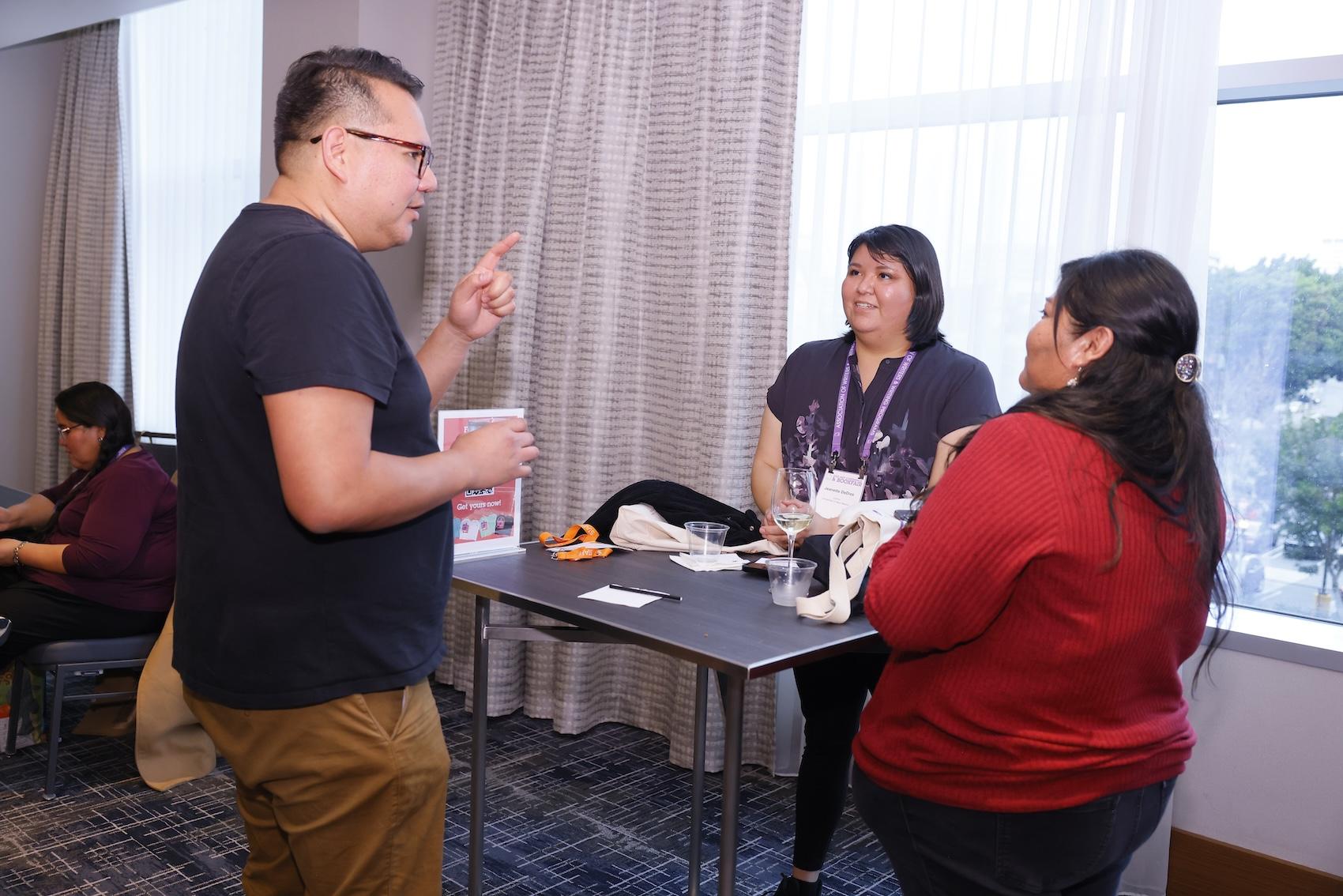
Student Fellows
Shannel Garcia
Diné College
This past March, I had the opportunity and privilege to attend the 2025 AWP Conference in Los Angeles, California, as part of the TCU Fellowship Program. The conference and TCU program were richly informative, comforting in their mentorship, and incredibly helpful in their insights and teachings.
I started out connecting and reconnecting with amazing fellows, writers, and educators. Seeing Dr. Shaina Nez and Chris Hoshnic again was a delight and comfort. Meeting the student fellows, Cheyenne Williams and Aziza Smith, was a pleasure. Meeting Jake Skeets and Laura Tohe was an incredible and encouraging experience. I also got to meet many amazing fellow writers and educators who were all supportive and gracious enough to welcome me.
I attended several informative and incredibly helpful panels. I was lucky enough to get some amazing insight into Diné teaching and methods. To question in a diverse classroom, How do we honor these spaces, and what does respect and inclusivity look like to us and others? I got the chance to listen to some amazing Diné writers read their poetry. Chris, Cheyenne, Jalen, and Jalen’s words were inspiring, and I applaud their contribution to Poetry magazine. I witnessed what it’s like to be a queer Indigenous writer and how “beauty is permeable” and how “time is malleable,” and the importance of including queer POVs, my POV, in literature. And I learned how I can tackle writing about pain and emotional experiences. To “slow down where it hurts,” to find a balance between our rage and the person underneath who is hurt, and to show mercy not only for ourselves but for the reader as well. As well as other great presentations, discussions, and readings that reinforced my love and belief in writing.
#AWP25, thank you for being kind to me and encouraging my writing journey.
Chris Hoshnic
Institute of American Indian Arts (IAIA)
The AWP TCU Fellowship Program provided me with a transformative opportunity to attend the AWP Conference, a space that nurtured my growth as a writer and as an individual. This fellowship allowed me to connect with both old and new friends, each of whom shared in the deep and varied experiences that come with a life dedicated to writing.
First, I want to highlight my participation in a panel titled “Future Work / Beauty Work: A Reading Featuring New Diné Poets,” organized by Jake Skeets and moderated by Esther Belin. While I had already been invited to be a part of this panel, the TCU Fellowship made it possible for me to participate by accommodating my travel and stay. This experience was invaluable, providing me not only with a platform to share my voice but also with a deep sense of belonging within a larger literary community. Being surrounded by talented Indigenous creatives and engaging in meaningful conversation reinforced my connection to the literary world, and I am grateful for the support that allowed me to be a part of this special event.
At the conference bookfair, I met the editors of various literary magazines as well, including those who have published my work. It was an absolute joy to put faces to the names and emails of the people who have supported my creative endeavors, reinforcing the importance of collaboration and shared commitment to storytelling. I also had the privilege of forming lasting connections with my fellow TCU fellows. Our shared journeys as Indigenous writers have fostered a bond that continues to flourish well beyond the conference. I am grateful to my mentors, Jake and Shaina, whose guidance and thoughtful craft talks not only enhanced my writing but also made me feel welcomed in a space where Indigenous voices are often underrepresented.
The AWP Conference, through this fellowship, has been pivotal in expanding my network, strengthening existing relationships, and solidifying my place in the broader literary world. For this, I am deeply grateful.
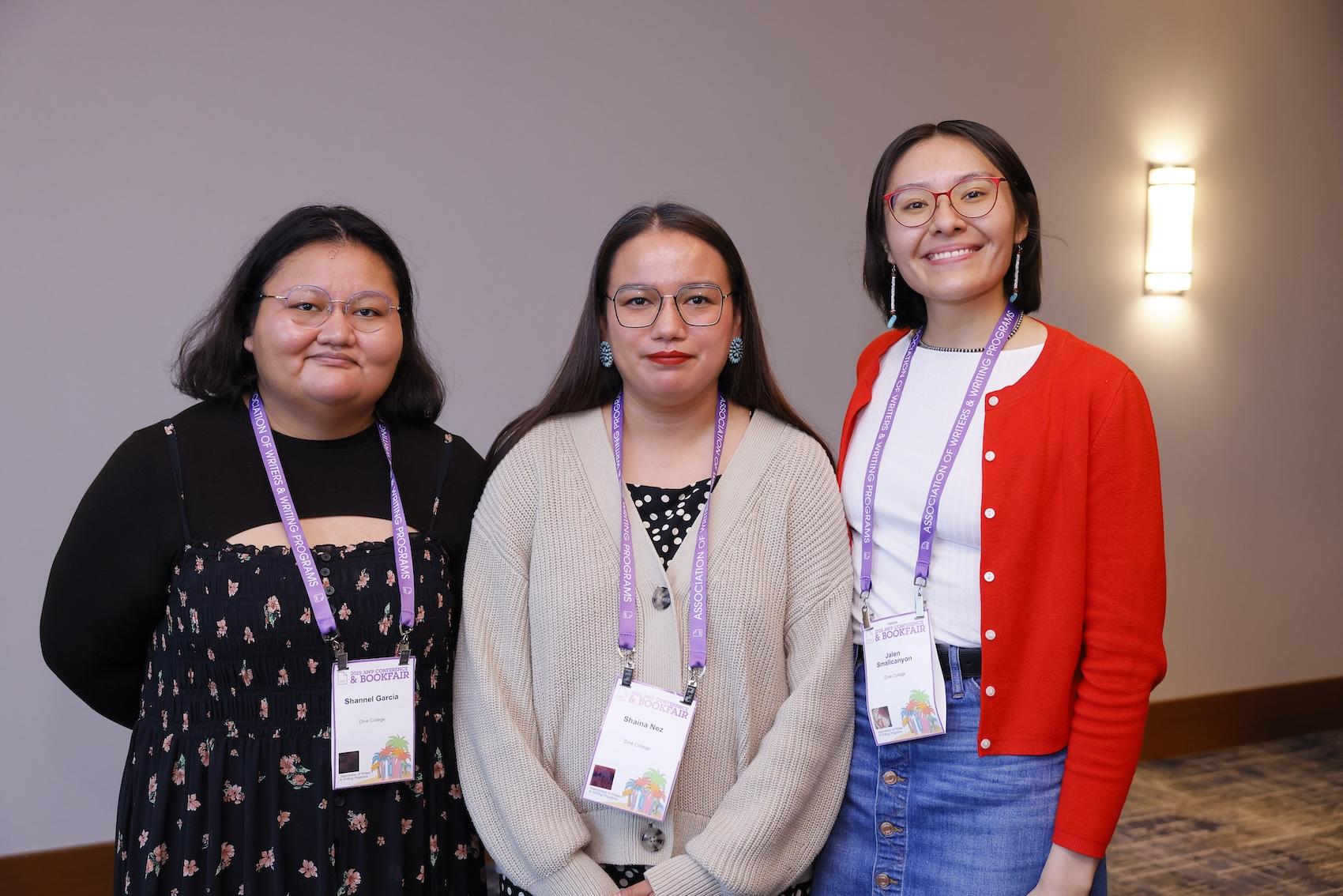
Aziza Smith
Haskell Indian Nations University
As I come from wide-open spaces of Wyoming and the Wind River reservation, the #AWP25 Conference and the TCU Fellowship felt like stepping into a literary galaxy—an unfamiliar world filled with voices, stories, and a copious amount of creative energy.
I deeply appreciated the TCU Fellowship as a commitment to expanding Indigenous voices. Though, as an enrolled member of the Eastern Shoshone tribe and an undergrad student pursuing business, my perspective is a little nuanced. My cohort consisted of me and three other students, and the three shared already established connections and a deep familiarity with the current Indigenous literary scene. While the strong emphasis on Diné poets and their comradeship illuminated the vibrant literary production of the Diné people, it also illuminated a particular focus within the fellowship on the literary traditions and current voices of the Diné people. It sometimes left me feeling like an outsider, merely looking in. However, my background in business and lack of engagement with formal creative writing contributed to the unfamiliarity of shared references and connections. Nonetheless, my perspective is not to diminish the positive aspects of the fellowship or any achievements of its members. I only intend to highlight the program’s strong alignment with a particular tribal literary community.
The TCU Fellowship allowed me to explore the vastness and diversity of a literary landscape I never knew before. The size of the bookfair and the volume of panels and presenters was an incomparable introduction to the diverse world of creative literature. I wanted to learn more ways to incorporate creative expression at my college, and the sessions that explored the intersections of poetry and climate, the craft of short story writing, and the works of Indigenous poetics through speakers such as Jake Skeets taught me a multitude of ways to make that happen.
Overall, the #AWP25 TCU Fellowship was a substantial introduction to the once unfamiliar world of creative literature. It provides such a unique entry point, and while the emphasis felt particularly tailored, it still ignited a deeper appreciation for the stories and Indigenous voices contributing to the literary galaxy. Most Indigenous students come from storytelling ancestors, and we need more Indigenous perspectives in this written world. The fellowship is a valuable experience that expands horizons while sparking newfound curiosity in creative Indigenous voices.
Cheyenne Williams
Fort Lewis College
As I reflect on my time spent at this year’s AWP Conference in Los Angeles, California, I am overcome with gratitude for the unforgettable experiences I had in being selected in the inaugural TCU Fellowship Program. This fellowship gave me the confidence to continue pursuing writing as a full-time career, and showed me the possibilities that exist for me in the literary world.
The inaugural reception was my favorite part of the whole experience, as I was able to be in a room with so many Indigenous writers and poets that I admire and look up to, such as Esther Belin, Kimberly Blaeser, Jake Skeets, and Laura Tohe. I will not forget how I felt during the reception, which was an overwhelming feeling of belonging in having found community among the Indigenous writers in attendance, along with a feeling that I was exactly where I needed to be in following my ambitions in poetry. Without this community, I do not think I would be the poet I am becoming today.
While at the conference, I was given a last-minute offer to be a part of the panel titled “Future Work / Beauty Work: A Reading Featuring New Diné Poets.” This was my first time speaking on a panel, where I read two poems of mine that were featured in the March issue of Poetry magazine. Sitting next to Chris Hoshnic during the panel, and having it be moderated by Esther Belin, was another hybrid moment of both kinship and affirmation, especially when people in the audience came up and expressed their resonance with the sentiments I shared during the panel, further reminding me of the strength in my words.
I am grateful for this opportunity provided by the fellowship, as I have created lasting memories and new friends. I hope to continue to build a lasting career committed to writing and poetry, and this experience has given me the assurance in moving forward.