The AWP Writing Organization Award annually recognizes writing conferences, festivals, centers, workshops, residencies, retreats, and other organizations for the important work they do to serve the writing community. AWP recognized the 2026 winner, CantoMundo, at the 2026 AWP Conference & Bookfair. Below is a reflection from Belinda Acosta, director of CantoMundo.
As the director of CantoMundo, I am often asked why poetry matters. CantoMundo, for those who don’t know, is an annual retreat where Latin@/x/e poets are cultivated. It’s easy to sneer at poetry these days; to belittle its usefulness in a hypertransactional world, driven by getting more than is needed, often at the expense of others. And yet, every June, poets who embody different aspects of Latinidad come together in community with invited faculty to discuss craft, be inspired, and create new poems.
When the bitterness of the world threatens to overwhelm me, I remember that we all start as poets. All of us, from the moment we grasped a crayon, to happily scrawl on paper, walls, and floors. Maybe those marks were indecipherable to everyone, including our child selves, but who does not remember the joy of making those lines dance, of seeing them sing? Sadly, the expanse of our imagination is corralled once we enter conventional school systems, where imagination is tamped down in the service of obedience. But listen to a child acquiring language, or to a person from another part of the world learning English. Can you remember how a new tongue used incorrect words with an earnest need to be understood and unknowingly created poetry?
CantoMundo is not just about poetry. It is also about claiming literary space. The breadth and depth of Latinidad have often been overlooked, diminished, or reduced to nothing more than a bright travelogue of charming words, images, or cultural references.
When I accepted the AWP Writing Organization Award for CantoMundo in Baltimore, it was on behalf of all who came before me—the founders who imagined CantoMundo into existence; the volunteers who took up the helm when it moved in a new direction; the poets who attended retreats and made lifelong friends; the writers who moved from writing poetry to prose; and even those who, for a time, wondered if the challenges of maintaining the organization was worth it. If there is one thing I can say about the enormous need for CantoMundo, it’s that I believe, with no irony, cheekiness, or snark, that poetry is a source of wonder and unspeakable beauty. “Wonder is a liberation practice,” Cole Arthur Riley reminds us in Black Liturgies. And wonder is desperately needed in our tarnished world. It not only matters, it’s worth fighting for.
A poem can be a prayer. A chant, or a promise. It can be the anthem longed for in a noisy world. The response to chaos, bigotry, and the absurdity of fascism. It’s where hard truths can be told or where astonishing beauty erupts despite being surrounded by efforts to normalize the inhumane. Poetry matters.
In the last paragraphs of Tobias Wolff’s famous short story “Bullet in the Brain,” we are taken back to a warm summer day on a baseball field, where the jaded main character remembers being a young boy, hearing another young boy say (in imperfect English), “Shortstop. Short’s the best position they is.” The jaded man remembers reveling in the unexpected beauty of those words. Not because they are grammatically precise, but because of their music; and the elation found in the perfect imperfectness becomes a mantra to close the story, “they is, they is, they is.” I remember gasping as I read “Bullet in the Brain” in The New Yorker. Since then, it’s been widely anthologized and taught in numerous classes. I’ve taught it in creative writing classes, watching young minds savor the words on their palette with pleasure. But I also remember sitting in undergraduate and graduate creative writing classes, where my voice, my history, my people were diminished, often offhandedly, sometimes overtly. I remember one undergraduate writing class where a distinguished professor decided to make an example of me, saying that the “Hispanic” experience was not useful to me as a writer. Although a shy student at the time, I entered a combative one-on-one with the professor that made my voice crack, while the other students sat wide-eyed and silent. After class, students told me how “brave” I was to stand up to him. Is it brave to refuse erasure?
 During my MFA years, I heard critique after critique after critique that the Spanish I’d used (infrequently) in my prose was bothersome and that my imagery was unrealistic. I’d written a child narrator who compared a pile of used tamale husks to a pile of unpaid bills and was told that children do not know about unpaid bills. As a child who grew up in poverty, I did. And then, there was the time the benefactor of my MFA program told me, “It’s too bad you’re not Cuban. Cubans are big right now.” I laugh at these microaggressions today, but when it comes to CantoMundo and the young or new writers I meet, I become downright feral in defending the need for a space for these writers to connect, to create, and flourish, now more than ever. It’s people who look like me, speak like me, or have an immigrant history like mine who are being targeted, expelled, or disappeared in ghastly numbers, as if we did not have a part in building this nation, physically and artistically.
CantoMundo is more than a writing retreat. It’s where poets from across Latinidad can see each other, begin to dismantle internalized racism, interrogate colonial-fueled biases, and finally, honor and celebrate our place in the kaleidoscopic diaspora of Latinidad.
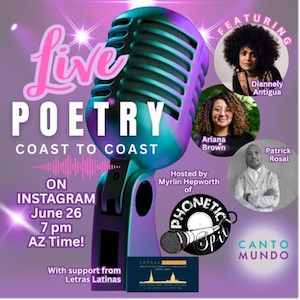
I invite you to celebrate with us. A live public reading during the June retreat takes place on June 26, 2026, at 7:00 p.m. Phoenix time, and will be carried live on social media. If you happen to be in the Tempe area, drop into the Virginia G. Piper Center at Arizona State University. Otherwise, a recording will be shared later. Until then, include Latinx poets in the Sealey Challenge to read a new poet each day in August and remember how much poetry matters.
CantoMundo cultivates a community of Latinx poets through workshops, symposia, and public readings, and celebrates the breadth of Latinidad.