Last week, Regis University’s Mile-High Creative Writing Program hosted three poetry readings, a screenwriting table read, nine English-themed TED Talks, and a National Poetry Month library exhibit. Last month, we sent three undergraduate student writers to present at the National Undergraduate Literature Conference. And last year, we announced the launch of a new bachelor of fine arts in creative writing—the only one in the state of Colorado and in the AJCU, the network of US Jesuit colleges. At a time when liberal arts colleges across the country are in upheaval, why is creative writing thriving at our campus? And what does a five-hundred-year-old religious order have to teach us about creative writing? What, exactly, is “Ignatian creative writing”?
The Society of Jesus (or “Jesuits” for short) is an order of Roman Catholic clerics founded in 1540 by Saint Ignatius of Loyola. After an injury left him temporarily bedridden, Ignatius read about the lives of the saints and gave up his career as a soldier to pursue a life in service to others. Books revealed Ignatius’s vocation to him, and books are what he offered back to the world. At age thirty-three, he attended grammar school alongside boys as young as eight; he then went on to study theology and Latin at university and even earned a master’s degree. In 1540, Ignatius founded the Jesuit order, an organization dedicated to missionary work, education, and social justice.
Five hundred years later, Regis University, one of more than 180 Jesuit-founded institutions in the world and 27 in the US, continues Ignatius’s work by providing accessible, high-quality education rooted in the core Jesuit mission of serving others. Not all our students and faculty are Catholic, or even religious, but we all live and work with a deep sense of purpose inspired by our history. We focus on caring for the most marginalized in the world, on being contemplatives who take action against injustices, and on finding God (or goodness, meaning, or beauty) in all things.
Our creative writing programs, including our new BFA as well as our long-standing and prestigious low-residency MFA, are animated by these same values. Our students write poetry, fiction, essays, and screenplays that can change the world. We write for peace and justice in our communities, for greater empathy for our neighbors, and for solidarity with those who have been harmed by systems of oppression. We write to celebrate the dignity and diversity of all people, to encounter the most difficult human questions, and to cultivate our attention toward the inherent beauty and meaning in all the world around us. Creative writing at Regis is both a fascinating field of study and an entire way of life.
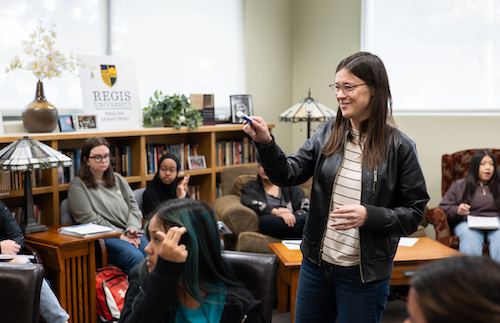
One of the signature assignments of our MFA program is a Writing in the World Plan that students create before their final residency or semester. In it, we ask them to consider a community audience they plan to support and engage using their newly honed writing skills, after they leave our program. This assignment has resulted in a myriad of projects providing both our graduates and their communities with artistic stability. For instance, alum Troy B. Allan’s work with writing and equestrian therapy in rural communities landed him a job at Utah State University Extension leading initiatives in rural mental health, community wellness, and veteran support. Troy’s MFA thesis manuscript, In the Shadows: Essays on Seeing, was also recently published by Tactical 16 Publishing, and his work was referenced in a New York Times article, “Another Giant Leap Reminds Us How Small We Are,” about the Artemis II mission and spirituality. Additionally, our graduates have gone on to run reading series, small presses, and journals, and to run youth writing programs and literary conferences, among much more. The Jesuit emphasis on social justice in action makes our programs successful beyond our classroom walls.
Another Jesuit philosophy that guides our pedagogy is cura personalis, meaning “care for the whole person.” Our MFA program operates with a one-to-one mentorship model that allows students to develop their own independent studies, which culminate in their final thesis manuscript. Many of these thesis manuscripts have gone on to be published, with over thirty of our graduates obtaining book deals on their writing projects in the last ten years. Some highlights include Aura: A Memoir by Hillary Leftwich, The Bloodweaver by C. N. Kuster, and a record of how the mother’s textile became sound by Nawal Nader-French.
In short, a Jesuit creative writing education is individualized and emphasizes care for the whole person. It is community focused and social justice oriented. And it is grounded in the belief that creative writing in particular and a liberal arts education in general can make a real impact on people’s lives in the world.
Alyse Knorr is an associate professor of English at Regis University. She is the author of the poetry collections Wolf Tours (2024); Ardor (2023), a Lambda Literary Award finalist; Mega-City Redux (2017); Copper Mother (2016); and Annotated Glass (2013). She also authored the video game history books GoldenEye (2022) and Super Mario Bros. 3 (2016) and four poetry chapbooks. Her work has appeared in The New Republic, Poetry, Alaska Quarterly Review, Denver Quarterly, and The Georgia Review, among others.
Andrea Rexilius is the author of Séance of the Bees (2026), Sister Urn (2019), New Organism: Essais (2014), Half of What They Carried Flew Away (2012), and To Be Human Is to Be a Conversation (2011), as well as editor of the anthologies We Can See into Another Place: Mile-High Writers on Social Justice (2024) and The Braided River: Activist Rhizome (2015). Rexilius is the program director for Regis University’s Mile-High MFA in Creative Writing.