On Wednesday, March 4, 2026, AWP will host a reception and book signing to honor the 2024 AWP Award Series winners and the partner presses who published their winning manuscripts. Meet the authors, purchase their books, and celebrate their work at the 2026 AWP Conference & Bookfair.
AWP Awards Reception & Celebration
Wednesday, March 4, 6:30–8:00 p.m. ET
Renaissance Harborplace Hotel
The AWP Award Series is an annual competition for the publication of excellent new book-length works in four categories: poetry, creative nonfiction, the novel, and short fiction. Below are details about the winning authors and newly published books we’ll be toasting in Baltimore.
2024 Sue William Silverman Prize for Creative Nonfiction
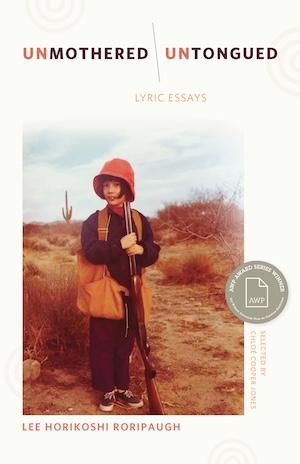
unMothered, unTongued
Lee Horikoshi Roripaugh
University of Georgia Press
“unMothered, unTongued is an extraordinary collection of essays that masterfully pushes the boundaries of nonfiction. The writing is simply exquisite. Each sentence sings with an elegant precision that cuts like a scalpel to the essence of self, memory, and place. This manuscript tackles nuanced questions of identity, family, culture while simultaneously reimagining the very limits of form and poetic prose. The results are breathtaking. I’m so grateful for this reading experience, one I will not forget.”
—Chloé Cooper Jones, 2024 judge and author of Easy Beauty
A collection of essays that thread themselves around the questions and complexities of language, landscape, and identity
unMothered, unTongued is a collection of lyric essays written from the liminal space of the in-between. These essays thread themselves around questions of language, landscape, and identity, weaving together intersectionalities and intertextualities. Author Lee Horikoshi Roripaugh, a biracial LGBTQIA+ Nisei who was born and raised in Laramie, Wyoming, to a non-native-English-speaking Issei mother, considers not only the tensions in the rifts between intersectional identities (biracial Nisei, LGBTQIA+) but also the tensions between marginalized identities and the landscapes and cultures of the American West; the tensions between nonnative, second, erased, and/or forgotten languages; and the tensions between those who abuse and those who survive. These rifts, intersections, and fractures, while frequently a source of violence and immense grief, are also a source of illumination and clarity. The essays in this collection are written almost entirely in hybrid/lyric forms—oftentimes braided, oftentimes patchworked, oftentimes segmented—reflecting some of the fractured complexities and intersections of Horikoshi Roripaugh’s own hybrid identities.
Read a sneak peek of unMothered, unTongued
Lee Horikoshi Roripaugh (she/they) is a biracial Nisei and the author of five volumes of poetry, most recently tsunami vs. the fukushima 50, a Best Book of 2019 by the New York Public Library and a poetry finalist in the 2020 Lambda Literary Awards. Her fiction collection, Reveal Codes, winner of the Moon City Press Short Fiction Award, was published by Moon City Press in 2023, and their chapbook, #stringofbeads, was published by Diode Press in 2023. A recipient of the Association of Asian American Studies Book Award in Poetry/Prose for 2004 and a 1998 winner of the National Poetry Series, Horikoshi Roripaugh’s poetry, fiction, and essays have appeared in Kenyon Review, Virginia Quarterly Review, American Poetry Review, Story Magazine, Terrain.org, Hotel Amerika, and North American Review, among other publications. Seven of their essays have been listed as Notable Essays in Best American Essays.
2024 James Alan McPherson Prize for the Novel
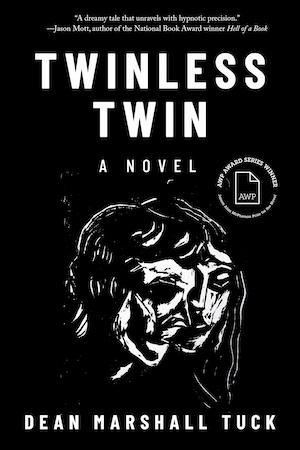
Twinless Twin
Dean Marshall Tuck
University of Nebraska Press
“A dreamy tale that unravels with hypnotic precision. A story of love and secrets, all played out against a backdrop of meticulous, flowing writing. The best stories are the ones that leave readers with decisions to make: about themselves, about life, about the world. Twinless Twin leaves readers with all of those difficult choices and more. It’s a novel that relies heavily on the established traditions of rural storytelling—with its tropes of magic, danger, and folklore—while grappling with contemporary themes with no loss of momentum or impact. In short: a wonderful story.”
—Jason Mott, 2024 judge and author of Hell of a Book, winner of the National Book Award
Twinless Twin finds a family maimed by a troubled, enigmatic son, whose unspeakable actions leave the family reeling, torn between moving on and searching for answers. A twin who survives their sibling twin may sometimes be plagued with lifelong feelings of loss, guilt, and even a strange sense of urgency—a need to live two lives in one. In this story, the tragedy of the lost child reverberates through the surviving sibling and ripples through the rest of the family and beyond.
Set largely in twentieth-century America in the foothills of an unnamed mountain, this insular landscape breeds rumor, legend, desperation, daydreams, and a mystery that runs deeper than the family who inhabits its woods. Raising questions regarding culpability in the face of tragedy and the responsibilities of those who remain after a family has been splintered, Twinless Twin ultimately asks: What must be done to salvage the family, their reputation, and their homeplace?
Read a sneak peek of Twinless Twin
Dean Marshall Tuck is a writer living in eastern North Carolina with his wife and daughters. His work has been published in Alaska Quarterly Review, Epoch, Witness Magazine, and elsewhere. Tuck serves on the advisory board for the North Carolina Literary Review and teaches writing at Wayne Community College in Goldsboro, North Carolina.
2024 Donald Hall Prize for Poetry
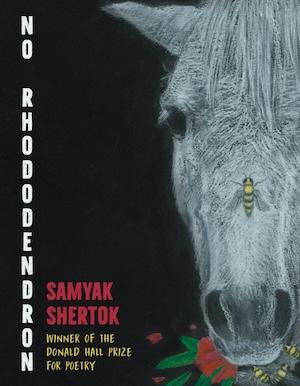
No Rhododendron
Samyak Shertok
University of Pittsburgh Press
“If poetry is, as has been defined, a species of magic, Samyak Shertok has conjured an elegant and sophisticated collection that is full of hybridity in form and subject. In the lines ‘What is it that they say about the tongue? / Something like a feathered blade that belongs / only to the dead,’ we are given a view into the conjuring—his view on how language expresses and depresses, how language as noise can mix into cacophony or clarify home. Homes. Diaspora. Conflict—as simple as war and as ambiguous. In all the hybridity, Shertok has stayed and strayed from forms as in his sonnet sequence. Most thrilling are Shertok’s hybrid inventions, where forms are mixed to great effect: the ghazabun is ghazal and haibun, and the ghazanellet is his ghazal, villanelle, and sonnet. And further, he offers forms of his own making that twine together words and sense. There are quotes from sutras, from Blake, from family. There is abiding grief and, in that, surviving to tell and retell stories. This debut collection is an absolute marvel.”
—Kimiko Hahn, 2024 judge and author of The Ghost Forest: New and Selected Poems
Part elegy, part poetry of witness, and part poetry of exile, No Rhododendron is a lament to the poet-speaker’s father and fatherland and a grief-wrought love letter to his mother and mother tongue. The collection is haunted by an existential question about Shertok’s oral mother tongue, Tamang: How do you write about a language that has no script? Exploring the erasure, ambiguity, multiplicity, violence, and unknowability signified by “X,” the poems dwell on the lip of a new ghost language, which ultimately fails itself. The polyphonal witnessing of the decade-long Maoist conflict in his native Nepal from schoolchildren’s perspective reveals how a war can fracture the psyche of an entire generation. The final thread of the book, a “reverse-elegy” for his mother, meditates on the impending loss of a loved one as a potential site of mourning, impermanence, gratitude, memory-making, and mythopoeticism.
Read a sneak peek of No Rhododendron
Samyak Shertok’s poems appear in The Cincinnati Review, The Gettysburg Review, The Iowa Review, The Kenyon Review, Poetry, Shenandoah, Best New Poets, and elsewhere. His honors include the Robert and Adele Schiff Award for Poetry, the Gulf Coast Prize in Poetry, and the Auburn Witness Poetry Prize. He has received fellowships from Aspen Words, the Helene Wurlitzer Foundation, and the Fine Arts Work Center in Provincetown. Originally from Nepal, he was the inaugural Hughes Fellow in Poetry at Southern Methodist University and teaches creative writing at Mississippi State University.
2024 Grace Paley Prize for Short Fiction
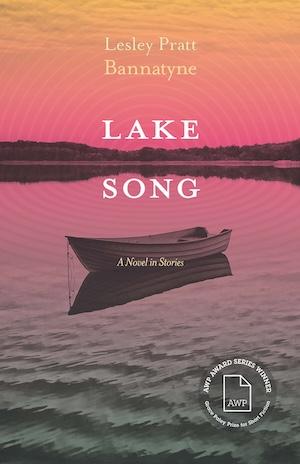
Lake Song
Lesley Pratt Bannatyne
Mad Creek Books/The Ohio State University Press
“[An] insightful, often drily witty novel-in-stories. . . . All of these finely crafted stories are haunted . . . not just by the dead but by missed connections, bungled romances, links broken between parents and children. These well-wrought miniatures add up to an engrossing multifamily epic.”
—Kirkus
“Kinder Falls is home to generations of folks who might consider their lives to be ordinary. Yet in Lake Song, their beautifully told stories are overflowing with delicious details and breathtaking revelations about love, family, grief, desire, regret, revenge, and every other facet of what it means to be fractured and human. This book dazzles and surprises, from page to page and decade to decade over the course of these finely wrought characters’ lives.”
—Deesha Philyaw, 2024 judge and author of The Secret Lives of Church Ladies
The linked stories of Lake Song, set in the fictional town of Kinder Falls in New York’s Finger Lakes region, span decades to plumb the complexities, violence, and compassion of small-town life as the twentieth century hurtles forward. Against a backdrop of historical events—bootlegging, Klan attacks, gold smuggling, the Albany Ketchup Murders, the 1965 Northeast blackout—a generations-long mystery unwinds. In 1906 Mavis Staunch drowns in Okisee Lake days after she refuses to sell her land to a trio of brothers. The same night, one of the brothers, Angus Epps, doesn’t come home. Few suspect the two events are connected, and no one imagines the role that a ten-year-old boy, a canoe, and a pack of coyotes play in the tragedies. Spiritualists, grifters, sugar makers, arsonists, seekers, and saleswomen wind through each other’s lives and across decades to add layers of resonance to each captivating story. The mercurial lake that unites the people of Kinder Falls sustains as much as it haunts, both witness and diary.
Read a sneak peek of Lake Songs
Lesley Pratt Bannatyne is the author of the short story collection Unaccustomed to Grace as well as fiction and essays in the Boston Globe, Smithsonian, Christian Science Monitor, and many literary magazines. Her latest nonfiction book, Halloween Nation, was a Bram Stoker Award finalist. Lake Song is her seventh book.