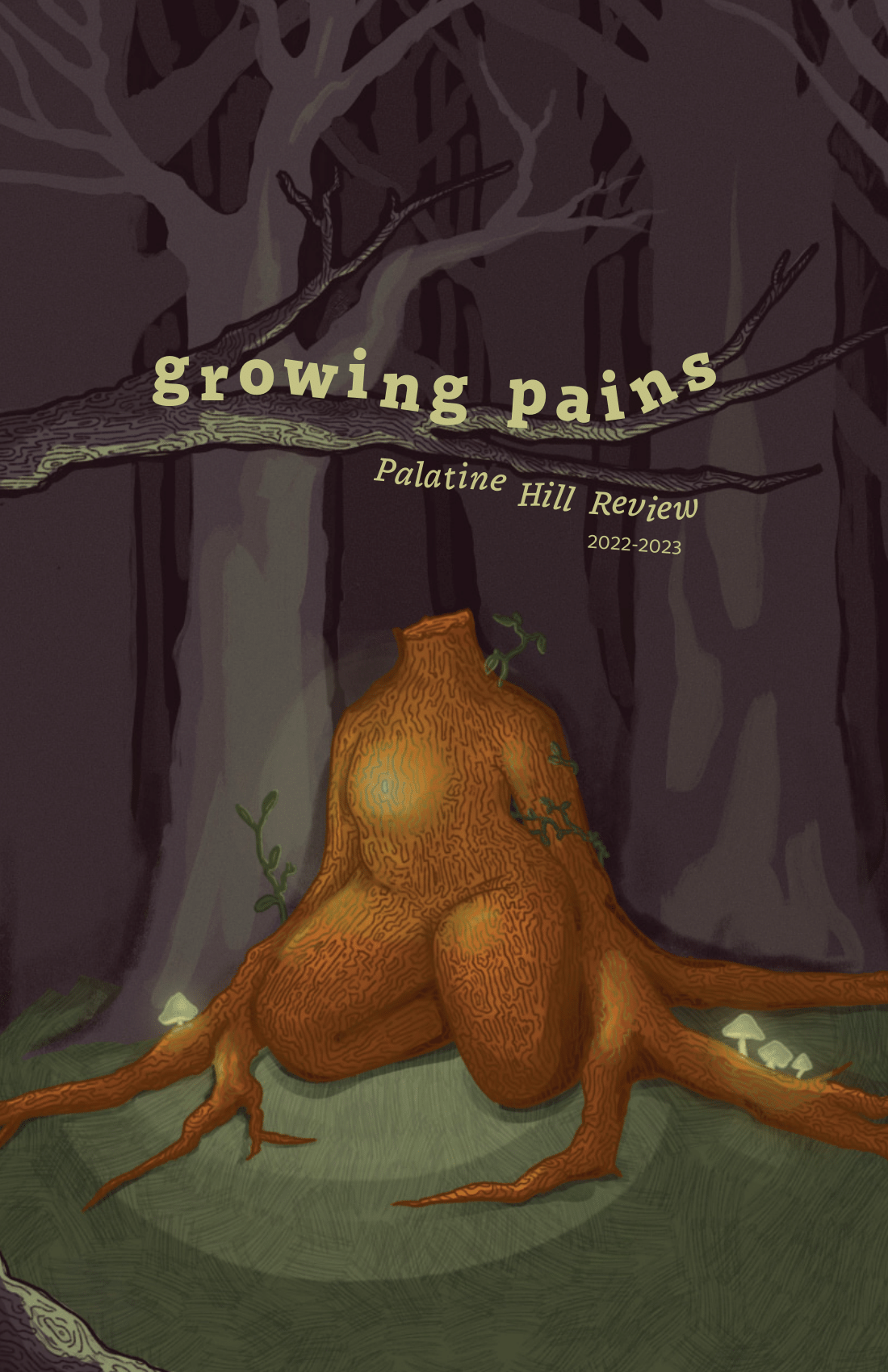
Formerly the National Program Directors’ Prize, the AWP Prize for Undergrad Lit Mags is awarded annually to one outstanding undergraduate-led journal and two runners-up. The prize celebrates the work of undergraduate student writers and editors, including exceptional content, cohesive design, and innovation. The 2024 winner of the AWP Prize for Undergrad Lit Mags is Lewis & Clark College’s Palatine Hill Review, edition 50, “growing pains,” selected by judge Erin Slaughter. Read notes from AJ Di Nicola (coeditor in chief along with Jillian Jackson) and Elizabeth Huntley (design editor) on the process of crafting such a successful issue.
Applications for the 2025 competition will open February 1–28, 2025. Lit mags housed by AWP academic program members receive one free submission per year.
Notes from the Editors
For the Palatine Hill Review’s fiftieth edition, “growing pains” could not be a more apt title. Like a fresh green sapling or a gangly teenager, the scope and scale of this edition grew beyond our wildest expectations.
First, “growing pains” comes in at 330 pages, almost twice as large as our previous largest edition (“bone meal,” from the previous year), and boasts 113 published pieces. In honor of our golden anniversary, fifteen pieces were reprinted from our archives, accompanied by reflections from the Lewis & Clark College alumni (in a few cases, former Palatine Hill Review editors in chief) and professor emeritus who wrote them.
Second, the graphic design of “growing pains” is the result of the first full year of our design board—open to all majors and class years, like our editorial board. If “bone meal” was us dipping our toes into the waters of full-color design work, “growing pains” was a dive, headfirst, into the depths of spread layout and design. This edition also had not one but four different covers, submitted by the community and selected by leadership, another first.
With all this growing came commensurate pains. Our staff collectively sunk hundreds of hours into reviewing, proofreading, ordering, designing, and reproofreading this edition—to say nothing of the long meetings, flurries of emails, and late-night texts that coordinated this work.
While it’s possible that we may never print an edition quite so large or staggeringly ambitious again, that means that “growing pains,” like a towering redwood, will forever stand out from the rest. Here’s to another fifty years!
—AJ Di Nicola & Elizabeth Huntley
Categories