The AWP Intro Journals Project is a literary competition for the discovery and publication of the best new works by students currently enrolled in AWP member programs. The 2025 winning pieces are published or forthcoming in participating literary journals: Colorado Review, Florida Review, Hayden’s Ferry Review, Mid-American Review, Puerto del Sol, Quarterly West, Reed Magazine, and Tampa Review.
Read excerpts from the 2025 winning pieces below.
Creative Nonfiction
Selected by AJ Romriell
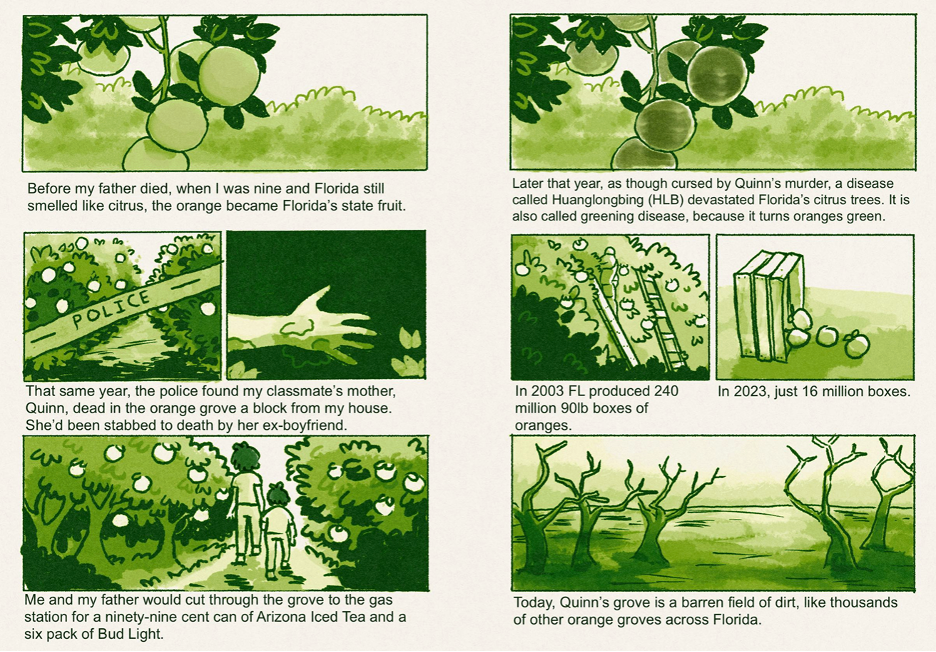
“Greening”
Tyler Balkcom
University of South Florida
Tampa Review
“Down and Out in Disneyland”
Maya Bernstein-Schalet
University of Arizona
Colorado Review
The Vrbo that we stayed in for Kealynd’s memorial was Disney themed. When I opened my eyes in the morning, Goofy stared back at me—actually, dozens of Goofys, plastered all over the walls. The Vrbo’s interior was inspired by the neighboring Disneyland Resort in Anaheim. And so, Elsa smized from a poster across from the toilet while I peed. A grinning Mickey and Minnie watched my aunt cry.
My cousin, Kealynd, was a dancer and a joker. He was as silly as he was stubborn. When he died of an overdose in August of 2021, he had been sober for six months, the longest time he’d been sober in years. He had a job he loved at Goodwill and a room in a sober house nearby. Kealynd met many of his friends in Anaheim through meetings or programs. At his memorial, one by one, they got up to speak. “This isn’t new for us,” a friend said. “We lose someone every couple of months. And it’s terrible. And I don’t know when it will stop.”
“My Gender in the Epipalagic Zone”
Ari Koontz
Northern Michigan University
Hayden’s Ferry Review
My Gender in the Epipalagic Zone
is the 52-hertz whale, or 52 Blue, or the loneliest whale in the world. First flagged by the U.S. Navy in 1989, he exists not in an aquarium or on any camera film but in the invisible sound-currents that undergird the northern Pacific. While trawling these waves for bomb-laden ships, they were surprised instead with his song: higher than the calls of the blue and fin whales that nudge the coastline in summer, lower and longer than the human ear can detect.
This whale is a creature of unidentified species and origin—maybe a hybrid, maybe a freak. Easy to mistake for the motor of a submarine, or deep-sea vents clicking open and shut. It’s likely the other whales can hear him, but they never match his pitch; either they don’t understand what he’s saying or they don’t try, too content with their own kind to reply.
Perhaps he travels in their pods sometimes, goes silent and tries to fit in. Perhaps these other bodies are a welcome harbor from the vast blue expanse of his solitude. But one can only be an outsider for so long. 52’s migration pattern is a mess of squiggles among gracefully curving lines, an orbit that stabilizes only when he is isolated from the rest. From the Aleutian Islands to the Californian shallows he roams, he searches, letting out his scratchy plaintive call that has never been answered by a neighbor or daughter or mate.
The biologists say that this isn’t unhealthy. That being lonely is less significant than being alive. And they know he is alive—this whale has grown and matured and lived on through decades of singing himself to sleep, returning to their sonar scans faithfully each year. He’s still out there, diving and breaching, filtering tiny creatures through an enormous mouth, expelling his sighs as puffs of salt spray.
“Spread”
Katie Rhodes
University of Southern Mississippi
Florida Review
1. Suburbia
When I was 14 my friend showed me the empty wrapper of the condom used to take her virginity the night before and the friction between body and girlhood ruptured. Frost overtook the cottonwoods outside. I thought of anatomical diagrams folded into educational pamphlets, the word “erection” dripping from the corner of my 5th grade teacher’s mouth. The sensation of my mother’s hands clapping down over my eyes in a dark theatre, and the feeling that what I’d just seen was forbidden and ripe.
*
Jean shorts, black eyeliner. My bare legs are pressed against the stone countertop of a kitchen I don’t know and my eyes can’t hold focus. The smell of cherry vodka thick like cough syrup in the air, lace tank tops cut low on top and creeping high on the bottom. Our shoes slap the wet pavement under streetlights, shadows and legs reaching long against the backdrop of suburbia, fillies running violent. I slide into the asphalt and bleed and laugh at how it doesn’t hurt.
“To Shoulder the Weight”
Josiah Roberts
Point Loma Nazarene University
Mid-American Review
Carter was murdered on a surf-trip in Mexico, and I lodge the pain in the corner most mornings. Not that day. That day I paced. Read a collection of poems Gyasi wrote for him that morning and couldn’t sit still. Gyasi spoke of grief latched like a leech to skin, and I read his words until the letters jumbled. I paced and clutched my chest. I grabbed my hat and ended up on the pavement with shoes tied. I left my earbuds at home and tried to take things in: murmurs of old ladies walking crusty, white dogs; humming trucks; hopping crows; my heavy breathing and all.
A garage door opened, a front door shut, a plane scraped the clouds above. It all just kept moving. I counted neighbors, noted the sway of leaves, pulled the memories like teeth and cast them to the asphalt. Observation as bandage. Carter ran beside me. We didn’t talk much, just counted together: one old man packing golf clubs into the back of a black SUV; one young man with a sleeve of tattoos by the elementary school; two children at his side, backpacks bouncing with their footsteps; one soiled, bloody tissue; one empty Ziplock with a brown residue—the breeze rustled it, but it didn’t slip away. It will slip away. My feet pelted the concrete, and Carter told me to grab the breeze and ride it like a fucking bull. I’m not sure what he meant, but I laughed. It’s weird the way you can still hear their voice. The way they could almost recount the whole thing like a joke.
Around the next bend, the ocean sprawled, and I heard a wail stab the open sky.
Fiction
Selected by Uche Okonkwo
“Blue Heaven”
Carter Groves
University of Missouri–Kansas City
Quarterly West
The year the winter was snowless, I spent every school night at Blue Heaven Funeral Home & Cemetery, where my mom worked as a funeral director. My dad wasn’t around anymore, so when I accrued charges of truancy, larceny, and vandalism, the only punishment Mom could afford to supervise was to keep me exiled from civilization at her workplace. I must have done something irredeemable that gray January. I have vague memories of a burning nativity scene, or maybe that was when I left high-dose pot brownies on the hermit veteran’s doorstep. In either case—an accident or a gift—I believed I did nothing to deserve a month of isolation, a blurred string of early-dark evenings.
Every other sophomore was out getting their driver’s license, and those lucky enough to have their own car became completely estranged from their homes. Jalen Porter did—apparently he was seeing a senior girl over in Oneida on and off—but he wrapped his car around a tree a few days after we got back from winter break.
Jalen and I weren’t friends, but we often crossed paths in the administration offices at Hopewell High. Onetime, he brought a bottle of military-grade malodorant to an assembly and dumped the whole thing under the bleachers. It smelled like nuclear fallout. Somehow I was falsely accused—despite having two (admittedly unreliable) skaters as alibis. I took the fall for it. Jalen was popular and congenial, so it was endearing when he committed the same transgressions for which I was called a freak.
“Used Books”
Serena Kerkstra
Georgia College & State University
Puerto del Sol
Imogen’s day begins when Gil’s parrot starts to sing. Every morning at six o’clock, his song rises through the floor, a nine-note mimicry of a television jingle. He repeats the tune until Gil wakes up and lets him out of his cage. Gil is a heavy sleeper; sometimes Imogen listens to the parrot sing for nearly an hour. She imagines leaving her room and letting him out herself, maybe opening a window and ushering him to freedom. But Gil is kind to her, pays her twenty dollars an hour for simple work, and rents his spare room to her for a small fraction of her paycheck. The old man only has one request: don’t touch Butch Cassidy.
“He doesn’t trust strangers,” Gil explained four months ago. Imogen hid behind her case manager’s shoulder while he spoke, hugging a papery drawstring backpack that contained Salvation Army clothes, a toothbrush encased in plastic packaging, and a chocolate bar from the hospital. In the corner of the bookstore, Butch Cassidy perched between a whirring vintage television and shelves stuffed with VCR tapes, eyes wide and wings flapping as he frantically squawked “ghost!” in her direction.
“He’ll get used to you,” Gil continued, apologetic, “but please give him space.”
It was October then. Gil insisted that Butch Cassidy had been watching too many Halloween movies. But the weeks proceeded, the season grew frigid, and Butch Cassidy still squawked “ghost!” whenever he saw Imogen. She knew she looked like some wisp of smoke instead of a girl, just bones wrapped in white skin the same sickly color as the split belly of a fish.
“Rhapsodic”
Kelly Ward
West Virginia University
Reed Magazine
The first time Cynthia saw her electric angel was on her eleventh birthday at her home in Little Lake Trailer Park in Rosslyn, Kentucky.
It began as a normal birthday. All of Cynthia’s aunts and uncles in the park were there, grilling hot dogs, sipping on wine coolers and beer, speculating between cigarettes about how long Uncle Bruce’s new marriage (his fifth in five years) would last. Cynthia’s brothers and sisters and cousins played tag while Cynthia sat alone at the picnic table beneath the maple tree in her yard and whispered the lyrics of Barry Manilow’s 1981 ballad “Somewhere Down the Road” to a stink bug that was crawling on her arm.
She opened all her normal gifts—thrifted Barry Manilow records, one of which included a fold-out poster of the 1970s heartthrob with his swooping blonde hair and dazzling blue eyes; a leather-bound collection of Lord Byron’s poetry—and thought it was time to blow out the birthday candles on her red velvet birthday cake when her mom placed one more present in Cynthia’s lap.
“For my special little girl,” said her mom, who wore so much dangling silver jewelry on her neck, fingers, and ears she sounded like wind chimes when she moved. “Your Aunt Madeline gave me my first deck when I was your age. I wish she was here to see you now.”
Cynthia unwrapped the present to find a deck of Rider-Waite Tarot cards in her hands.
“Whichever card you draw first from the deck,” her mom whispered, “will shape you for the rest of your life.”
Cynthia ripped the plastic casing off the cards with her little teeth. The “Four of Wands” fell into her lap.
Poetry
Selected by jo reyes-boitel
“Pantoum Where We Must Commit to Dancing with Death”
Jacob R. Benavides
Oklahoma State University
Reed Magazine
This is the death dance &
I need a fucking cigarette
before I haunt you forever.
I will hold this delicate pose,
I told you, I need a fucking cigarette
before I die for you on wisps of ash,
I crush this delicate pose
with the brevity of a violent kiss.
Before I die for you in a whisper of ash
I tell you—I have seen death every day
& life taken with the brevity of a kiss.
Trans desire murdered for daring to burst.
“Exile”
Ben Cooper
Salisbury University
Colorado Review
It goes like this: everything
you’ve ever known, left to look
toward the last flicker of the fading
before. It’s the same closed sky
on the same lonely patch. It’s the birds
going quiet in winter. It’s the leaving
in sunlight, the returning
in rain.
“Abecedarian of things to do while you’re waiting to feel”
Elizabeth Garcia
Georgia State University
Florida Review
Abecedarian of things to do while you’re waiting to feel
better. / Blink.
Clean the sink. / Scrub it
down to its first shining self. / Believe
even objects have some / inner light, the way, last night, the moon
foraging in your mulch became / the armadillo.
Give yourself time / measured in
half-lives, a promise / the sky will one day recall
its color.
“Bullseye”
Camilo Loaiza Bonilla
University of South Florida
Hayden’s Ferry Review
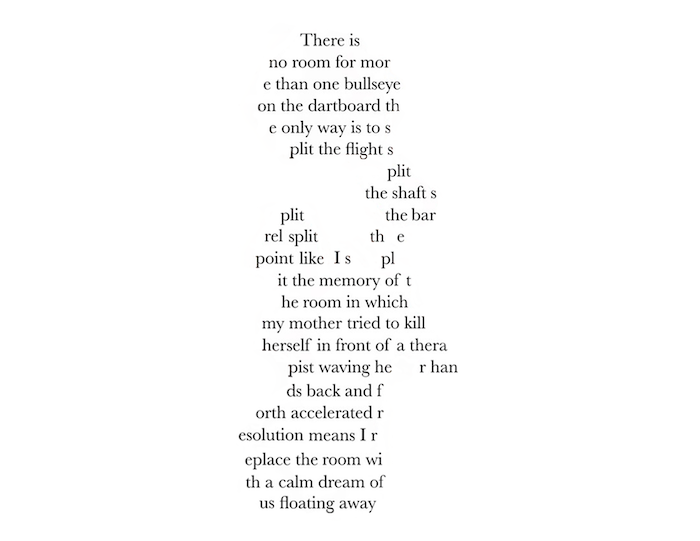
*The full version of this poem includes accompanying imagery, forthcoming in Hayden’s Ferry Review.
“Unbury my childhood”
Heather Neidlinger
Western Kentucky University
Quarterly West
Unbury my childhood and I will scatter from the hurt of it.
Each limb and atom spread wide to let years,
burned from the mad dash of impossible avoidance, pass.
I drink, and smoke, and gather could-be lovers around
to smother the memories I do not have. I tell myself
I do not have them. Get them out of my sight, I’ll say,
but at night the pieces will quilt my bedding.
Those single digit years lay rotten at the far edge of this landscape,
where a home juts out built from dandelion memories.
“I’m writing you an elegy at the edge of the world”
Sophia Saco
University of Central Florida
Tampa Review
I’m writing you an elegy at the edge of the world,
fingers stinging with citrus and soul aching with loneliness. I plucked an
orange from your neighbor’s yard, hope you don’t mind. The
branches are weighed down with rot and neglect. If you were here, you’d
roll up your sleeves, snip away at any hint of death. You’d try and make
me help. This street is one long stretch of despair. But this orange was a
breeze away from splattering juice. Only one flies hadn’t touched. Worth
it. My hands got cut up, though, climbing to your roof—it’s been a while.
“Thoughts & Prayers”
Merrick Sloane
University of Tennessee
Puerto del Sol
when Nex died, the principal was picking her teeth
three high school girls were braiding each other’s hair, building a burn book, licking blood off their talons
“Nonbinary teen’s death renews scrutiny of anti-trans rhetoric”
renews
like easter morning & a dead body
“莫生 Only Absence, No Time”
Cela Xie
North Carolina State University
Mid-American Review
麻 Night falls like the tower
木 burning on that lucid shore —
待 I am burning, we are burning
火 on this frantic shore, laden with the
炼 gold and lead of our hours at ease,
为 for these are labor days, when we lead
空 lives we imagine are our own